

Video Mapping Loops is the long-running art project of new media artist Alexander Kuiava: monochromatic 3D animations built for one purpose — to bend the geometry of a building with nothing but light. The first collection was produced in 2011 and given away for free at a VJ meeting in Poland in 2012.
The premise is almost embarrassingly simple. A projector cannot emit black, so black is where the light stops. Between white and black there is a gradient — and inside that gradient a flat facade opens into depth. Every loop in this project is a study of that single transition.
Role & Scope
- Concept & method
- Art direction
- 3D animation & motion design
- Content production
- Research & education
Milestones
- Premiere: Space VJ Meeting, Wolsztyn, Poland — 2012
- First 3D mapping loops pack released for free
- 30+ collections produced to date
- Course material at Frontskill Institute
2010 → 2012
“Every client wanted to see the show before the show existed. I had to invent a way of showing it.”
The origin: a preview problem that turned into a medium
Around 2010 Alexander Kuiava began working in projection mapping. Almost every client asked to see a preview of the future show before signing anything. Producing a full custom show on spec was an unacceptable risk, so a different answer was needed: content that could turn a photograph of any facade into a convincing 3D preview within minutes.
Architecture looks endlessly varied, yet it repeats itself. Facades share a rhythm of floors, window rows, bays and symmetry. Once buildings are grouped by those patterns, universal content becomes possible. As a motion designer and compositor, Kuiava began animating the transformations that architecture invites: particle sweeps, extrusions of cubes, octagons, rectangles and triangles, waves, displacement, pixel sorting and glitch — each crossed with a direction of movement, from top to bottom, side to side, centre outwards or edges inwards.
That crossbreeding of geometry, motion and direction became the visual language of the project. The preview tool quietly became the show itself.
In spring 2012 the first video mapping loops reached a live audience at the Space VJ Meeting in Wolsztyn, Poland, on an invitation from the late VJ Diabolos. The pack travelled on discs and cost nothing. Vol.1 was a public test; the response made the next step obvious. Vol.2 “Smart Reflection” followed as the first commercial collection — a deliberate mix of extrusions, distortion, pixel sorting and glitch, so that every artist could find their own entry point.
2012
Year the first free video mapping loops pack was presented in Poland
30
+
Collections produced since the first volume
10
k+
Artists, studios and event producers working with the loops
Projection mapping is only a game of light and shadow
Alexander Kuiava, in an interview for LUMEN magazine. The sentence is still the shortest possible description of the whole project.
How the 3D depth effect actually works
The method is built on one physical limitation of the medium. Understanding it is enough to make architecture move.
Black is not a colour
A video projector mixes red, green and blue light. Switch every channel to maximum and you get white; switch them all off and you get nothing at all. Black in projection is simply the absence of light. Project in near darkness and the white areas of a loop light up the facade, while the black areas fall away into an abyss. The gradient between them reads as shadow — and shadow is what the eye interprets as depth.
The anatomy of a loop
Structurally, most video mapping loops follow one dramatic curve: black, white, black. The clip opens in darkness, an animation rises through grey gradients to a full white wash that floods the whole facade for a second or two, then the outro dissolves back into emptiness through patterns, extrusions and geometry. Because the curve is luminance-driven, the same clip also works as a luma transition or a mask — the loop is a source material, not a finished statement.
Universal by design
Buildings differ, but their proportions rhyme. Two, three or four storeys; four, five or six windows across the front elevation. Designing against those recurring patterns instead of a single address makes one animation fit hundreds of facades. That is why the same collection can deform a baroque town hall, a concrete panel block and a museum wall — and why a show can be storyboarded before the first site visit.
One photograph of a facade, one loop, one blending mode — the preview exists in seconds.
Drop a loop over a frontal photograph of the building, apply Stencil Luma in After Effects or blend the two layers in Resolume Arena or MadMapper, and the composition is ready to project. No plugins, no scripts, no heavy 3D pipeline. The same file that sells the idea to the client is the file that runs on the night.
After Effects · Stencil Luma
Resolume Arena
MadMapper
No plugins · No scripts
How artists use video mapping loops
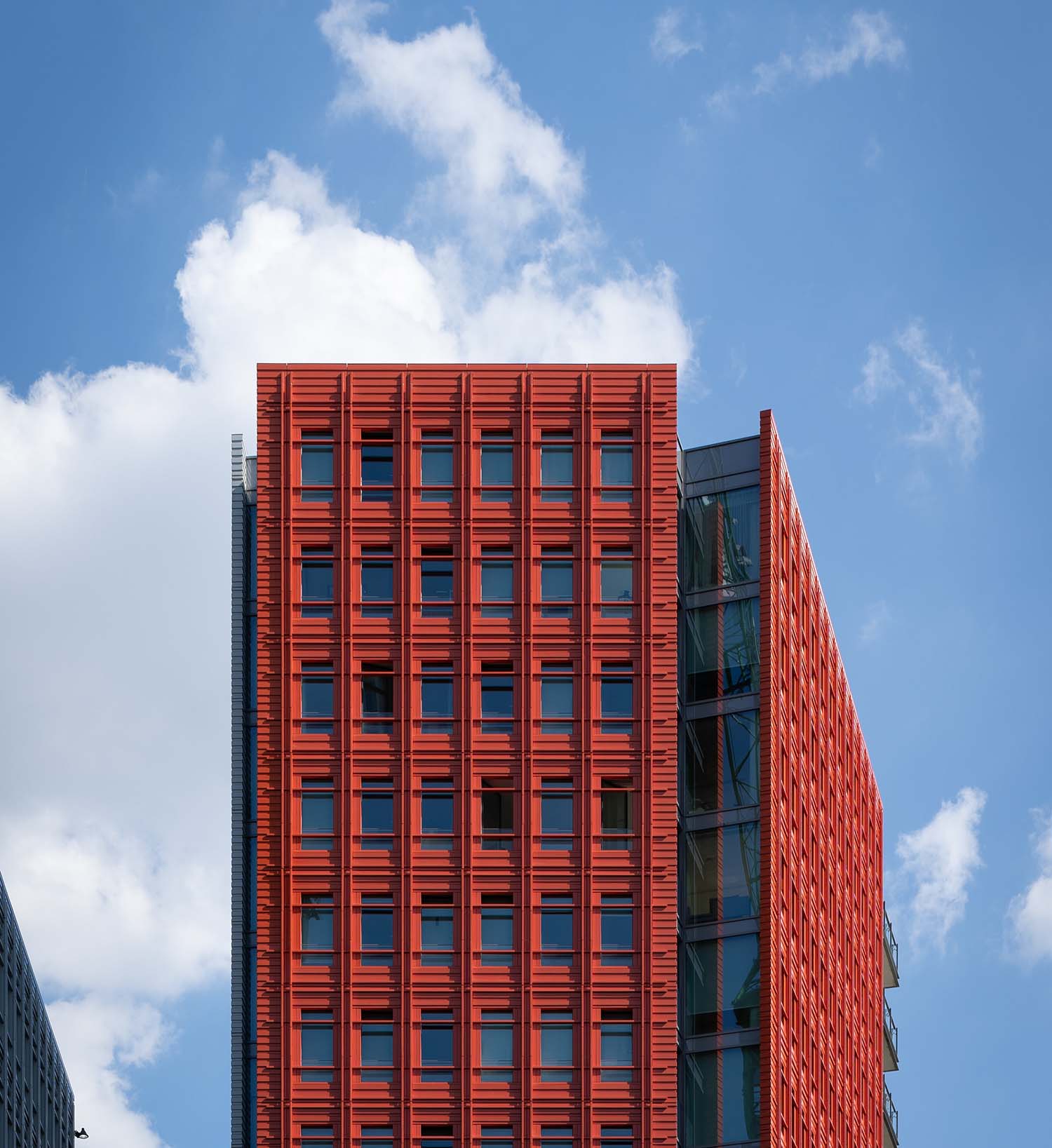
Projected onto a facade, the loops distort the original geometry of the architecture. Walls fall, cornices extrude, windows sink into the wall and whole elevations breathe. Nothing is added to the building; the illusion lives entirely in the contrast between the lit surface and the dark.
This is also the fastest route from idea to pitch. A frontal photograph of the building, one clip on top of it and a luminance-based blending mode are enough to show a client exactly what the evening will look like — long before a projector is ever rigged.
Because each clip travels from black to white and back, it doubles as an editing tool. Use it as a luma matte, a deforming mask, a displacement map or a video transition between two very different scenes in an audio-visual set.
The base structure is meant to be rewritten. Re-cut it as black, white, grey, black. Stack two clips, add a strobe to a single element, retime the outro, invert the curve. The loop is raw material for compositing, not a finished piece.
Facades are only the most public application. The same monochromatic language reshapes gallery walls, theatre sets, panoramic interiors, exhibition rooms and dome surfaces, where light and shadow define the volume of the space itself.
In an immersive room the effect changes character. Instead of demolishing a wall, the loop dissolves the boundary of the room, so the audience stands inside the animation rather than in front of it.
A greyscale animation with a clean extrusion is a gift to a 3D artist. The same files serve as animated displacement or bump maps, as video textures on models and environments, and as generative surfaces inside game engines and real-time scenes.
On stage the loops behave like percussion. Triggered against colour layers in a VJ set, a monochrome extrusion becomes a rhythmic accent that cuts through any palette without fighting it.
Authorship
“The format has been copied many times. The gradient is where the copies always fall apart.”
An ongoing project, not a finished catalogue
More than thirty collections later, Video Mapping Loops is still an open body of work. Every new volume tests one more way to break a surface: falling walls, fluid fabric, wire textures, panoramic sweeps, extrusions that keep folding into themselves. The vocabulary grows, the rule stays the same — light builds, shadow carves.
The official producer of the collections is the Austrian video production studio LIME ART GROUP. They are distributed through the projection mapping microstock Video Mapping Store and the project showcase videomappingloops.com, and they are given to students of the new media art school Frontskill free of charge as course material.
Widespread imitation followed the format almost immediately. Low-contrast copies are easy to spot: the gradients are dirty, the loop points are visible and the illusion of depth collapses the moment the projector fires. Depth is not a style — it is a discipline of luminance.
Video mapping loops FAQ
What are video mapping loops?
Video mapping loops are looped, mostly monochromatic video clips with a built-in 3D depth effect, made for projection mapping shows. They animate geometric objects through light and shadow, so that a projector can deform, extrude or dissolve the surface it is aimed at.
Who created the first video mapping loops?
Alexander Kuiava. The first collection was produced in 2011 and presented, together with the method behind it, at the Space VJ Meeting in Wolsztyn, Poland, in 2012. Volume 1 was released free to every participant of that meeting.
Why are the loops black and white?
Because a projector cannot emit black. White light illuminates the facade, black leaves it in darkness, and the gradient between them is read as shadow. Colour would flatten that reading. Monochrome is not an aesthetic preference here — it is what makes the depth possible.
Do I need 3D software to use them?
No. Take a frontal photograph of the facade, place a loop above it in After Effects and apply the Stencil Luma blending mode. The same result comes from blending the two layers in Resolume Arena or MadMapper. No plugins, no scripts, no heavy 3D pipeline.
Can video mapping loops be used outside projection mapping?
Yes. Their luminance structure makes them useful as luma mattes, video transitions, deforming masks and displacement maps in editing and compositing, as animated textures on 3D models, and as rhythmic layers in live VJ sets.
Where can I get the collections?
A curated selection is available as the Video Mapping Loops Bundle in the shop on this site. The full catalogue lives at videomappingloops.com, Video Mapping Store and LIME ART GROUP.
Turn a facade
into a moving
sculpture.
Ten volumes of video mapping loops are gathered into a single bundle — extrusions, falling walls, fluid fabric, wire textures and panoramic sweeps, ready to project.
Maria Art
Maria Art
VJ Video Mix
VJ Video Mix

Video Mapping Toolkits
Video Mapping Toolkits

Video Mapping Loops
Video Mapping Loops
Eurovision Song Contest